Tendering Guide
Catering
Catering companies tender for school meal programs, hospital food services, corporate event contracts, government function catering, aged care dining, military mess operations, and airline meal supply agreements. These are often high-volume, long-term contracts with strict food safety, dietary, nutritional, and reporting requirements. Evaluators prioritise food safety management systems, allergen controls, menu flexibility, supply chain resilience, and the ability to scale operations without compromising quality or consistency.
What evaluators look for
- Food safety management system certification (HACCP, ISO 22000, or local equivalent)
- Allergen management and cross-contamination prevention procedures
- Menu diversity, nutritional compliance, and accommodation for cultural and dietary requirements
- Supply chain transparency, local sourcing commitments, and contingency plans for disruptions
- Staff qualifications — food safety supervisor certificates, food handler training records
- Capacity to scale for fluctuating volumes and multiple simultaneous events
- Sustainability practices — waste reduction, composting, sustainable packaging, ethical sourcing
Tips for a winning bid
Make your food safety credentials the first thing evaluators see
Your HACCP plan, food safety supervisor certificates, and most recent audit results should appear in the first pages of your response. Include your temperature monitoring procedures, cold chain management, allergen labelling system, and cross-contamination controls. This is almost always the first pass/fail gate in catering tenders — if it's missing or vague, your bid won't progress regardless of price.
Design sample menus specifically for this contract
Never submit your standard catering menu. Design menus tailored to the client's specific audience and requirements — school children need different options than corporate executives, and hospital patients have different nutritional constraints than event attendees. Address halal, kosher, vegan, gluten-free, and allergen-free requirements with specific menu items, not a footnote saying "available on request."
Demonstrate supply chain resilience with specific supplier relationships
Name your key food suppliers, describe your backup arrangements for each critical ingredient category, and explain how you manage seasonal availability, price fluctuations, and supply disruptions. Mention local sourcing percentages and any ethical or sustainable sourcing certifications. Supply chain transparency increasingly carries significant evaluation weight.
Detail your end-to-end logistics model
Walk evaluators through your complete process: food preparation, quality checks, packaging, transport (including temperature-controlled vehicles), on-site service, and post-event cleanup. Include your staffing model with ratios, uniform standards, food handling certifications, and how you accommodate last-minute volume changes of 20% or more.
Include high-quality photos and measurable client outcomes
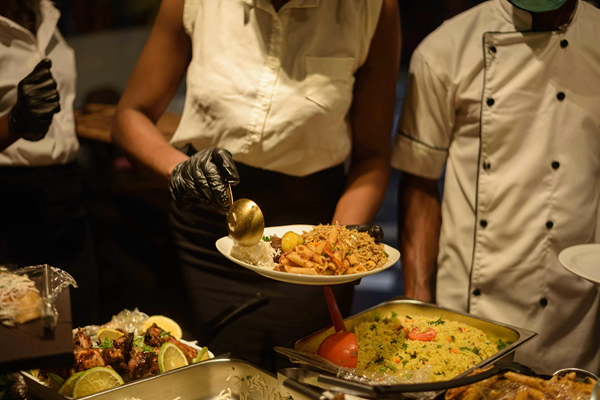
Catering is experiential — evaluators want to see presentation quality, not just read about it. Include professional photographs of past events at a similar scale, client satisfaction survey results, and any industry awards. If you can include a metric like "98.5% client satisfaction rating across 340 events in 2024," that's far more compelling than generic testimonials.
Common mistakes to avoid
- Submitting expired food safety certificates or incomplete HACCP documentation
- Offering generic menus that don't address the client's specific dietary policies and audience
- Not describing allergen management procedures in sufficient operational detail
- Underestimating logistics costs for remote, multi-site, or high-altitude delivery contracts
- Failing to address sustainability, waste minimisation, and packaging reduction requirements
The winning edge
The strongest catering bids tell a story about the complete dining experience, not just the food. Describe the presentation, service style, and ambiance you create. Include a full sample week of menus with nutritional breakdowns and allergen matrices. Make the evaluator feel confident that their stakeholders will be genuinely delighted — not just adequately fed.
Sources & further reading
- Food safety standards and requirementsOfficialFood Standards Australia New Zealand (FSANZ)
- Restaurant & Catering AustraliaR&CA
- AusTender — find & respond to Australian Government tendersOfficialAustralian Government — Department of Finance
Ready to analyse your catering tender?
Upload your RFT document and get every requirement extracted into a structured checklist.
Start Analysing